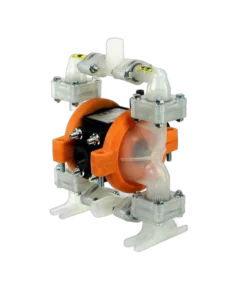
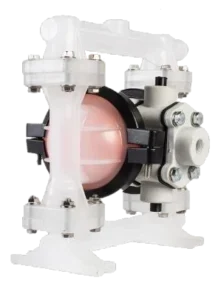
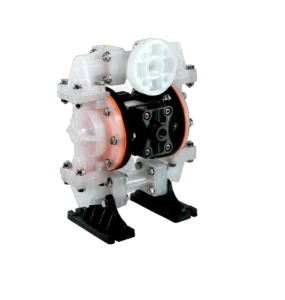
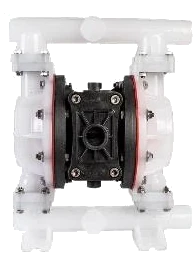
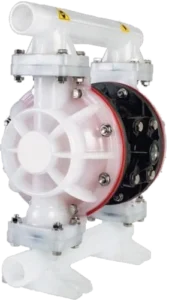
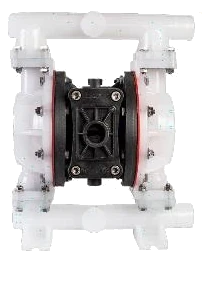
Diaphragm
The heart of the pump. Made of PTFE, EPDM or NBR; flexible membrane that pushes and pulls the fluid.
Technical Guide
Comprehensive introductory guide to the working principle, components and application areas of the AODD pump.
Basic Knowledge
The Air-Operated Double Diaphragm pump (AODD) is a type of pump that operates with compressed air, is self-filling and resistant to dry running. It has two symmetrical pump chambers; each chamber has a diaphragm and the diaphragms move alternately to push the fluid.
The central air distribution valve directs the compressed air to both sides in turn. The left diaphragm is pushed forward while the right diaphragm retracts; the fluid is directed through the suction and discharge valves. Thanks to this mechanism, the pump produces a smooth, pulsating flow.
Pump Anatomy
The heart of the pump. Made of PTFE, EPDM or NBR; flexible membrane that pushes and pulls the fluid.
Non-return valve that controls the suction and discharge directions. Also known as a ball or ball valve.
Automatic transmission valve that directs compressed air sequentially into both pump chambers.
It is selected according to the fluid and environment with PP, PVDF, aluminum or SS316L options.
Advantages
A diaphragm pump is a positive displacement pump that draws and discharges liquid through the back-and-forth movement of a flexible membrane. In the air-operated double diaphragm (AODD) version, this movement is provided solely by pressurized air; no electric motor or mechanical shaft is required. This fundamental characteristic makes AODD pumps safely usable in explosive environments, wet areas, and sites with limited electrical infrastructure. Pumpport responds directly to domestic industrial needs by designing and manufacturing this technology in Turkey.
Air-operated diaphragm pumps operate on the principle of a central air distribution valve (ADV) that connects two pumping chambers. While one side performs suction, the other side performs discharge; the rollers automatically reverse. Thanks to this synchronized operation, the flow is continuous and nearly pulse-free. AODD pumps can withstand dry running without damage; this characteristic provides a critical advantage that protects pump life during process errors and level fluctuations.
Plastic (PP, PVDF) and metal (aluminum, SS316) body options are designed according to different chemical environments and pressure requirements. Models with PP bodies stand out in acid and base transfer, while models with stainless steel or aluminum bodies are preferred in high pressure and abrasive fluids. The selection of diaphragm material such as PTFE, EPDM, Neoprene or Santoprene is the key factor determining operating temperature and chemical compatibility. The Pumpport product family presents this diversity under one roof, enabling engineers to meet all process points with a single supplier.
Series Comparison
| Feature | Plastic (PP) | Metal (PA) | Hygienic (PH) | High Pressure |
|---|---|---|---|---|
| Body Material | Polypropylene (PP) or PVDF | Aluminum or SS316 | Electropolished stainless steel 316L | SS316 + pressure booster |
| Maximum Pressure | 8,4 bar | 8,4 bar | 8,4 bar | ~16 bar (with 2:1 booster) |
| Maximum Temperature (body) | ~65°C (PP) / ~93°C (PVDF) | Diaphragm attached | Diaphragm attached | Diaphragm attached |
| Diaphragm Temperature Range | PTFE: 4-104°C / Santoprene: -29-104°C | PTFE: 4-104°C / Viton: -40-177°C | PTFE 4-104°C | PTFE / Santoprene |
| Typical Application | Acid, base, chemical transfer | General industry, oil, solvent | Food, medicine, cosmetics | Filter pressure feed, paint |
| ATEX Compliance | Optional (conductive PVDF) | Yes | Yes | Yes |
| Outstanding Advantage | Low cost, corrosion resistance | Mechanical strength, long life | FDA-compliant CIP/SIP compatible material | High outlet pressure, compact |
Sectoral Use
Pumpport pumps with PP or PVDF bodies safely convey corrosive fluids such as sulfuric acid, hydrochloric acid, and caustic solutions. Conductive body and antistatic diaphragm options prevent static electricity accumulation in flammable solvent transfer.
The Hygienic (PH) series is used in the transfer of milk, fruit juice, sauce and syrup with FDA compliant materials and internal geometry that leaves no dead spots. The electropolished SS316L surface is fully compatible with CIP/SIP processes.
AODD pumps transfer mining slurries with high solids content and clay suspensions without clogging risk. Large internal passage diameter and powerful ball-valve system provide long service life in abrasive pulps.
Metal-bodied, ATEX-certified Pumpport models are preferred for the safe transfer of crude oil, diesel, solvents and oil derivatives. The non-electric operating principle directly supports zone-compliant installation.
PH series models with PTFE diaphragm; minimize the risk of cross-contamination in the transfer of active pharmaceutical ingredients (API), gels, creams and solutions. The dead-leg-free design provides critical advantage in sterile processes.
Treatment plants benefit from a reliable solution for transferring active sludge, polyelectrolytes, and flocculants. Its dry-run resistant design protects pump life in wastewater lines where level fluctuations are intense.
Our Products
Frequently Asked Questions
Information Center
Suction and discharge stroke step by step, AODD/EODD comparison, material selection guide.
ReviewPP or PVDF body, 7 bar, 16–894 lpm. First choice if chemical resistance is a priority.
ReviewAL / Cast Iron / SS316, 8.4 bar, −18°C. For heavy industry and petrochemistry.
ReviewAISI 316L, CIP/SIP compatible. FDA approved solution for food, pharmaceutical and cosmetic processes.
Review8.4 bar, 160 m delivery head. For filter press feeding and long line transfer.
Review380V electric drive, no compressor required. For 250-500 lpm constant flow requirement.
ReviewCheck the chemical resistance of the pump casing and diaphragm material as A/B/C/D from the table.