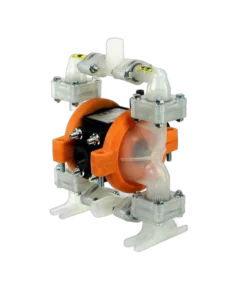
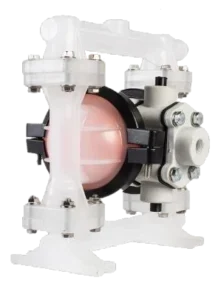
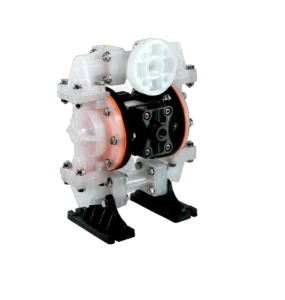
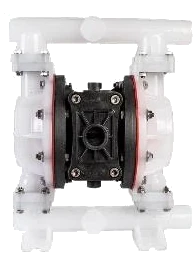
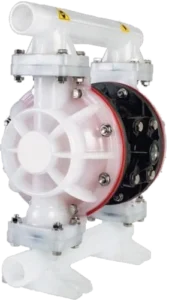
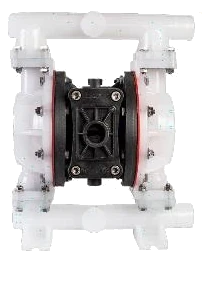
Dry Operation
Operates indefinitely without liquid. Pump does not suffer damage during tank emptying and process startup phases.
Technical Guide
Step-by-step pump selection guide for flow rate, pressure, fluid properties and casing material selection.
Selection Criteria
A mistake in AODD pump selection means inefficient operation, premature wear or unexpected failure. To find the right pump, you need to evaluate five key parameters in sequence: flow rate, pressure, fluid properties, casing material and installation environment.
This guide explains each step with concrete examples and ensures that you know what to ask our technical team during the selection process.
Working Principle
Operates indefinitely without liquid. Pump does not suffer damage during tank emptying and process startup phases.
Pump stops when discharge line is closed, automatically resumes when opened. Safe operation under back pressure.
No need for liquid to be present in the suction line beforehand. Pump draws by itself.
No mechanical seal leakage since there is no rotating shaft. Leak risk and seal maintenance cost are eliminated.
Requires only pressurized air. Provides natural advantage in ATEX Zone 1/2 explosive environments.
Transfers shear-sensitive fluids such as latex, paint, polymer, and food products without damage.
Wide internal passages allow mud, sludge, and particulate fluids to be conveyed easily.
Selection Criteria
Determine hourly or minute transfer amount. Leave %20–30 flow margin; if viscosity is above 500 cPs, base on %70 of catalog flow.
Calculate the sum of static height, pipe friction losses, and filter/accessory losses. Air pressure must always be higher than fluid pressure.
Viscosity, specific gravity, pH, temperature, and particle size directly determine selection. Manufacturer-approved elastomer required above 104°C.
Select body (PP/PVDF/Al/SS) and diaphragm (PTFE/EPDM/NBR) according to the fluid's chemical content. In case of diaphragm failure, fluid contacts the center body; center body material must also be checked.
Leave minimum %20 margin in compressor capacity. Use moisture separator and oil filter in high-frequency operation to protect air quality and pump life.
In ATEX Zone 1/2 environments, select ATEX certified pump. Metal body pumps must be grounded for static electricity.
Material Guide
| Material | Compatible Fluids | Incompatible / Caution |
|---|---|---|
| PP (Polipropilen) | Acid, alkali, salt solution | Aromatic solvents |
| PVDF (Kynar) | Strong acids, halogenated solvents, high temperature | - |
| Alüminyum | Neutral liquids, petroleum based | Acid, alkali, salt solutions |
| SS 316L (Paslanmaz Çelik) | Mild chemicals, food, pharmaceutical | HCl and chloride environment |
Diaphragm Guide
| Application | Recommended Diaphragm |
|---|---|
| Acid / Alkali transfer | PTFE or PVDF + PTFE |
| Petroleum / Fuel / Oil | Buna-N (NBR) |
| Food & Beverage | PTFE, Hytrel or Santoprene |
| Water / Wastewater / Sludge | Neoprene, Polyurethane or EPDM |
| Aggressive chemical / Solvent | PTFE or Viton (FKM) |
| Paint / Ink / Varnish | Santoprene or PTFE |
| Hygienic / Pharmaceutical | PTFE + SS 316L body |
| High wear / Solid particles | Neoprene or Polyurethane |
Sectoral Applications
| Sector | Typical Liquid | Recommended Configuration |
|---|---|---|
| Chemistry | Acid, solvent, aggressive chemical | PVDF/PP body + PTFE diaphragm |
| Food & Beverage | Sauce, syrup, beverage, cream | SS 316L + PTFE or Hytrel (FDA) |
| Paint & Coating | Paint, varnish, ink | Aluminum or SS + Santoprene |
| Mining | Mud, slurry, high solids | Aluminum/cast iron + Neoprene |
| Pharmaceutical / Pharmaceutical | Sterile liquids, API solutions | SS 316L + PTFE, hygienic design |
| Oil & Gas | Crude oil, fuel, waste oil | Aluminum + Buna-N |
| Galvanic / Coating | Acid baths, chemical solutions | PVDF + PTFE |
| Automotive | Lubricant, dye, solvent | Aluminum + Viton or Santoprene |
Pump Comparison
| Criteria | AODD | Centrifugal | Peristaltic | Piston Metering |
|---|---|---|---|---|
| Dry run | ✅ | ❌ | ✅ | ✅ |
| High viscosity | ✅ | ❌ | ✅ | ✅ |
| Solid particles | ✅ | ⚠️ | ✅ | ❌ |
| Dead-head protection | ✅ | ❌ | ✅ | ⚠️ |
| Self-priming | ✅ | ⚠️ | ✅ | ✅ |
| ATEX / Explosive atmosphere | ✅ natural | ⚠️ special motor | ⚠️ | ⚠️ |
| Precise dosing | ❌ | ❌ | ⚠️ | ✅ |
| High flow rate | ⚠️ | ✅ | ❌ | ❌ |
| Low cost | ✅ | ✅ | ⚠️ | ⚠️ |
| Easy maintenance | ✅ modular | ✅ | ✅ | ⚠️ |
Product Catalog
Election Questions
Information Center
Suction and discharge stroke step by step, AODD/EODD comparison, material selection guide.
ReviewPP or PVDF body, 7 bar, 16–894 lpm. First choice if chemical resistance is a priority.
ReviewAL / Cast Iron / SS316, 8.4 bar, −18°C. For heavy industry and petrochemistry.
ReviewAISI 316L, CIP/SIP compatible. FDA approved solution for food, pharmaceutical and cosmetic processes.
Review8.4 bar, 160 m delivery head. For filter press feeding and long line transfer.
Review380V electric drive, no compressor required. For 250-500 lpm constant flow requirement.
ReviewCheck the chemical resistance of the pump casing and diaphragm material as A/B/C/D from the table.