+90 554 128 90 95 [email protected]

Technical Guide

Diaphragm Pump
Operating Principle

From suction and discharge stroke to AODD/EODD differences, from component anatomy to material selection — comprehensive technical guide step by step.

  • Operating Mechanism
  • AODD & EODD
  • Material Selection

Basic Knowledge

Diaphragm Pump
How Does It Work?

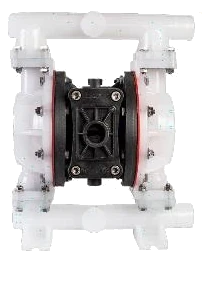
A diaphragm pump (membrane pump) is a positive displacement pump that performs liquid transfer through the back-and-forth movement of a flexible diaphragm. According to the positive displacement principle, the pump transfers a fixed and predictable liquid volume in each stroke cycle; this characteristic provides a critical advantage especially in applications requiring precise dosing and process control. It is widely preferred in dozens of industrial fields such as chemical processing, food production, wastewater treatment, paint transfer, and mining.

Due to pump design, the fluid does not contact mechanical moving parts; it only contacts the diaphragm and pump body. This sealed structure provides superior safety in terms of leakage and prevents cross-contamination of the fluid with the external environment or mechanical parts. This allows abrasive, viscous, solid particle-containing, or chemically aggressive liquids to be safely transported.

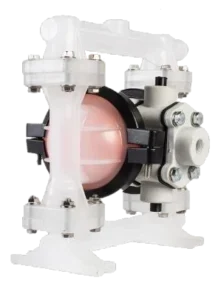
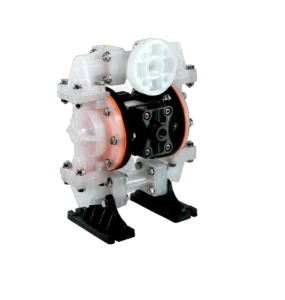
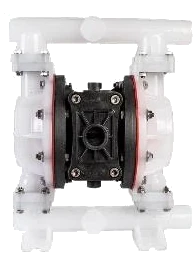
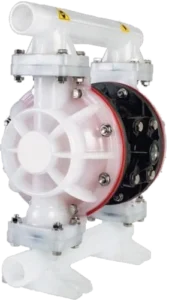
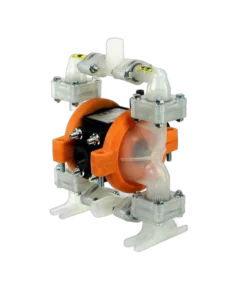
The most commonly encountered type in industrial applications is double diaphragm pumps (AODD and EODD), in which two diaphragms move synchronously but in opposite directions on a common shaft. This design provides both a smoother flow profile and longer component life. They are manufactured in a wide range of sizes and capacities, from small single diaphragm models to large industrial double diaphragm types.

Correct selection of body and diaphragm material directly determines the pump's chemical compatibility, service life, and safety. Models with polypropylene (PP) or PVDF bodies offer high resistance to corrosive chemicals, while stainless steel body hygienic models serve sectors with strict hygiene standards such as food, pharmaceutical, and cosmetic industries.
  • Positive displacement — transfers fixed volume in each stroke
  • Leak-free structure — fluid does not contact mechanical parts
  • Self-priming — no pre-filling required
  • Dry-run capable — pump is protected during level fluctuations
  • Wide fluid compatibility — acids, bases, slurries and viscous fluids

Comparison

AODD and EODD
Technical Comparison

Feature AODD EODD
Power Source Pressurized air (2–8 bar) Electric motor
ATEX / Explosive atmosphere Suitable as standard; certified models available Special ATEX motorized models required
Noise level Medium–High (air exhaust) Low–Medium
Energy efficiency Low (including compressor losses) High
Automation integration Limited (via air pressure) Easy (frequency converter, PLC)
Dry operation tolerance Short-term durable Short-term durable
Maintenance complexity Low — simple mechanical structure Medium — motor and electronic maintenance
Pulsation Medium (dampener recommended) Low
Flow Control With air regulator Precise with frequency converter
Infrastructure Requirement Compressor and air line Electrical line and panel

Pump Anatomy

Basic Components
and Functions

Diaphragm

Flexible membrane that creates vacuum and pressure cycle with back-and-forth movement. Manufactured from PTFE, EPDM, NBR, FKM or Santoprene material; correct material selection based on the chemical composition of the pumped liquid directly determines service life. Preference for PTFE diaphragm in solvent-based applications significantly extends life while NBR or EPDM offers economic alternative in water-based systems. Failure symptoms include leakage, performance degradation and liquid traces in air exhaust.

Diaphragm Shaft

Connects two diaphragms and ensures they move simultaneously but in opposite directions. Usually manufactured from stainless steel or PTFE-coated steel; this achieves long service life in corrosive environments. Loosening or wear at shaft connections disrupts synchronous movement and leads to irregular flow profile. Shaft seals and connection points should be checked during periodic maintenance.

Air / Power Distribution Valve

Transmission valve that controls stroke by automatically changing air direction. The pump's rhythm and stroke are determined by this valve; valve failure or contamination causes the pump to lock in one chamber or results in irregular stroke speed. In AODD pump this valve can be mechanical or pilot-operated; pilot-operated valve designs provide more reliable operation in high viscosity liquids. Regular air filter maintenance extends valve life.

Check Valves

One-way valves that control suction and discharge directions. Each chamber has one suction and one discharge valve; comes as ball (sphere) or flapper valve. Valve balls are selected from PTFE, EPDM, NBR or SS316L material to be compatible with the pumped liquid. Worn or contaminated check valves cause liquid backflow resulting in flow reduction and inefficient operation; this condition is a priority control point during periodic maintenance.

Pump Housing

Enclosed section where liquid is suctioned and discharged. Manufactured from PP, PVDF, aluminum or SS316L body based on chemical compatibility; body material selection directly affects pump service life and safety. In food and pharmaceutical applications, high-polish finishing of internal surfaces facilitates CIP (cleaning) and SIP (sterilization) processes. Cracks or color changes in the housing are early signs of chemical incompatibility.

Manifolds

Channels where inlet and outlet connections are made. Distributes liquid flow evenly to two pump chambers and can be supplied in different configurations according to line connection type (threaded, flanged or hygienic clamp). Manifold internal geometry affects flow resistance and turbulence; especially for high viscosity or particle-containing liquids, wide internal diameter manifold designs should be preferred. Gaskets and connection points should be regularly checked for tightness.

Material Selection

Body and Diaphragm Materials

Material Type Feature / Suitable Application
Polypropylene (PP) Body Acids, bases, corrosive chemicals — economical choice
PVDF Body Aggressive environments requiring high chemical resistance
Aluminum Body General industrial applications, solvent, oil
Stainless Steel 316L Body Food, pharmaceutical, cosmetic — CIP/SIP compatible, FDA material
NBR (Nitrile) Diaphragm Water-based fluids, mineral oils
EPDM Diaphragm Diluted acid and base solutions, hot water
FKM (Viton®) Diaphragm High temperature, solvent and fuel applications
PTFE (Teflon®) Diaphragm Highest chemical resistance — aggressive solvents, concentrated acids
Santoprene Diaphragm Flexible, general-purpose applications, long service life

Evaluation

Advantages and Limitations

Diaphragm pumps stand out with broad chemical compatibility, dry running tolerance and self-priming capacity. They offer distinct advantages over centrifugal pumps, particularly in the transfer of fluids containing particles, viscous or corrosive liquids.

On the other hand, diaphragm pumps have limitations that must be considered, as with any technology. For pneumatic models, compressor infrastructure at the facility is mandatory; this increases total system cost. Higher pulsation may occur compared to centrifugal pumps; this effect can be significantly reduced with a pulsation dampener but cannot be completely eliminated. For applications requiring very high flow rates, centrifugal pumps may be a more suitable and economical option. Selecting the pump type by correctly analyzing application requirements is critical for long-term efficiency and low maintenance costs.

  • Leak-free structure — fluid does not contact external environment
  • Dry running tolerance — waits undamaged for a short time
  • Waiting under load — automatically stops when discharge line closes
  • Submerged operation — air exhaust kept above liquid level up to 6 m depth
  • Caution: Pneumatic models require compressor infrastructure
  • Caution: Compared to centrifugal, pulsation may occur — can be eliminated with dampener
  • Precise dosing — controlled and repeatable flow thanks to positive displacement
  • Wide material compatibility — from abrasive chemicals to hygienic food liquids
  • Caution: For very high flow requirements, centrifugal pump may be more suitable

Frequently Asked Questions

Frequently Asked Questions Regarding Operating Principle

Standard models can transfer liquid from depths up to 6 meters. Beyond this value, cavitation problems may occur.
As a general rule, it operates in the 2–7 bar range. It should not exceed 7 bar; pressure should be adjusted with an air regulator. It is recommended to install a filter + regulator + lubricator (FRL unit) before the air line.
Performance decline, leakage, or increased noise are signals indicating the need for replacement. Under normal conditions, a PTFE diaphragm can serve 5,000–10,000 hours. Chemical damage or dry operation shortens this period.
Flow is smoothed by attaching a pulsation dampener (pulse flow damper) to the pump outlet. The dual diaphragm design already minimizes pulsation; a dampener provides additional optimization.
It is tolerant of short-term dry operation; however, long-term dry operation negatively affects diaphragm lifespan. This tolerance protects the pump in process lines and with level fluctuations.
AODD operates with pressurized air; it requires no electricity and is suitable for ATEX zones. EODD operates with an electric motor; it is quieter, more energy efficient, and suitable for automation integration. AODD requires compressor infrastructure, while EODD requires a reliable electrical supply.
In dampener selection, the pump's maximum working pressure, connection diameter, and chemical compatibility of the pumped liquid are determining criteria. Its volumetric capacity should be selected to be at least 5–10 times the volume of liquid transferred by the pump in one stroke. For chemically aggressive liquids, a dampener with a PTFE inner surface or PVDF body is recommended.
Yes; diaphragm pumps offer distinct advantages over centrifugal pumps in transferring high viscosity liquids. Fluids such as paint, resin, paste-like products and mud are successfully transported with this pump type. As viscosity increases, reducing stroke speed and keeping inlet/outlet connections wide preserves pump efficiency.
Diaphragm pumps; are widely used in the chemical, paint manufacturing, food and beverage, pharmaceutical and cosmetic, wastewater treatment, mining, petrochemical and electronic sectors. Material options that adapt to different fluids such as acids, bases, solvents, slurry, paint and food liquid form the basis of this wide field of application.
Diaphragm pump operates on positive displacement; transfers a fixed volume with each stroke and is self-priming. Centrifugal pump, on the other hand, provides continuous and high flow rate through rotor movement; however, it cannot self-prime, is not resistant to dry running and quickly loses efficiency with viscous liquids. Diaphragm pump stands out in low-medium flow, high pressure and difficult fluid applications while centrifugal pump is a more economical choice for high flow and low viscosity clean liquids.

For Your Application

Let's Choose the Right Diaphragm Pump Together

Share your fluid properties, flow rate and pressure requirements and we will recommend the most suitable model.

Ask Price