+90 554 128 90 95 [email protected]

Diaphragm Pumps

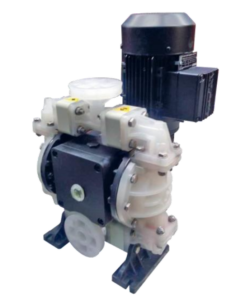
Electric Diaphragm Pump PE Series

A diaphragm pump that runs on 380V electricity without requiring an air compressor — with the advantages of fixed flow rate, low operating costs and easy maintenance.

  • Compressor-free 380V Operation
  • Fixed Flow Control
  • Resistant to Dry Operation
  • 3–4 kW Efficient Motor

About PE Series

Electric Diaphragm Pump Why Is It Preferred?

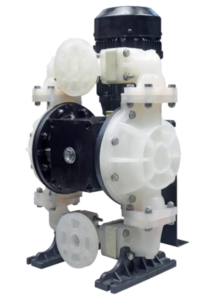
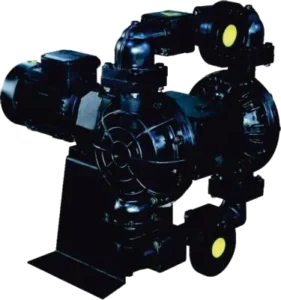
Electric diaphragm pumps (PE Series) combine the reliable diaphragm operating principle of pneumatic AODD pumps with an electric motor, offering a solution that does not require an air compressor. The PE 20 (3 kW, 250 lpm) and PE 30 (4 kW, 500 lpm) models, which can be connected directly to a 380V 50Hz power supply, provide the opportunity to continue using diaphragm pump technology in facilities without compressor infrastructure, in fields where the compressor is to be removed, and in applications where operating costs are under pressure.

Compressor operating costs occupy a noticeable place in the facility's total energy expenses. An air compressor; motor consumption, maintenance costs, oil and filter changes, dry cooling or aftercooler and pipeline pressure losses combined effect increases the actual unit energy cost. The PE Series eliminates this layered cost; the energy converted directly from the electric motor to mechanical movement operates the pump's diaphragm. Its constant speed and constant flow characteristics provide a regular and predictable flow profile in line filling requiring process control, chemical dosing supply lines and transfer applications expecting uniform flow.

The PE Series' dry-run resistance is maintained at the same level as its air-driven sister series; when there is no fluid, the motor remains unloaded and the diaphragm remains in standby without damage. The polypropylene-bodied PE 20 offers broad chemical resistance for the chemistry and paint-coating sectors, while the aluminum-bodied PE 30 is suitable for wastewater, petrochemical, and mining applications requiring mechanical strength and higher flow rates. The elastomer option offers two different chemical compatibility classes as Santoprene and Neoprene; the correct selection based on application directly affects maintenance intervals and diaphragm life.

  • No air compressor needed — direct connection to 380V 50Hz mains supply
  • PE 20: 250 lpm / 3 kW — PE 30: 500 lpm / 4 kW power efficiency
  • Fixed flow rate characteristic — process control and regular flow in line filling
  • 5 bar maximum pressure, 50 m delivery head
  • Resistant to dry running — no pump damage in level fluctuations
  • PE 20 PP body / PE 30 aluminum body — both models easy maintenance modular design

Technical Specifications

Prominent Advantages of the PE Series

Operation Without Compressor

The PE Series makes it possible to use diaphragm pump technology in facilities without air infrastructure. Compressor installation costs, maintenance, and energy consumption are eliminated; investment payback period is shortened.

Low Power Consumption

PE 20 model operates at 3 kW and PE 30 model operates at 4 kW motor power with high efficiency. Compared to a compressor + AODD system with the same flow capacity, the actual unit energy cost remains significantly lower.

Fixed and Predictable Flow

The constant speed characteristic of the electric motor eliminates flow rate variability caused by air pressure fluctuations of the pneumatic pump. Automatic line filling provides a reliable flow profile in processes requiring chemical transfer and uniform flow.

Endurance to Dry Work

Diaphragm design makes dry running harmless in the PE Series, which is a critical failure cause in centrifugal pumps. When the tank empties or the process stops, the pump waits without damage; when fluid returns, it resumes operation smoothly.

Chemical Resistance

The PE 20's polypropylene body offers high chemical resistance against acids, bases, and non-polar solvents. The PE 30's aluminum body is preferred for applications where mechanical strength is a priority. Both models are available with Santoprene and Neoprene diaphragm options.

Easy Maintenance

Through modular diaphragm group design, diaphragm replacement can be performed in field conditions without requiring special tools. The motor and pump head can be serviced independently; this feature reduces total maintenance time and spare parts inventory requirements.

Model Comparison

PE Series Model Technical Values

Model Connection Maximum. Debut Maximum Pressure Engine Power Body
PE 20 2'' 250 lpm 5 bar 3 kW / 380V Polypropylene (PP)
PE 30 3'' 500 lpm 5 bar 4 kW / 380V Aluminum (Al)

Frequently Asked Questions

Frequently Asked Questions About Electric Diaphragm Pumps

If you already have an air compressor on site and capacity is sufficient, pneumatic AODD pumps are generally preferred; flexibility and ATEX compliance provide advantages. If there is no compressor infrastructure, compressor installation is to be avoided, or constant flow rate and low operating costs are a priority, the PE Series is a more economical and practical choice. Both share dry-running-resistant diaphragm technology.
Yes, in most scenarios. When compressor installation costs (equipment + piping + electrical panel), maintenance expenses (oil, filters, aftercooler), energy losses (including pipeline pressure drops) and depreciation are evaluated together, the total cost of ownership (TCO) of the PE Series generally comes out lower. This difference is most pronounced in single pump applications requiring flow rates up to 500 lpm.
The PE 30 model can reach a noise level of 90 dBA under maximum operating conditions. This value exceeds the 85 dBA action limit of OSHA and EU Occupational Health directives; therefore, the use of hearing protective equipment and/or the application of acoustic enclosures may be required at the installation point. Positioning the pump in a separate machine room is a practical solution.
Standard PE Series operates at constant speed; coarse flow adjustment can be made with line valves or bypass line. For applications requiring precise flow control, a frequency inverter (VFD) can be added to adjust motor speed and thus pump flow proportionally. We recommend consulting with our technical team for VFD compatibility.
In wastewater treatment facilities, PE Series pumps are widely used as polymer and flocculant transfer lines, sludge dewatering feed lines, and chemical dosing support pumps. Resistance to dry running is a critical characteristic that protects pump life in these applications where level fluctuations are intense. It is a particularly practical choice for open-field treatment plants without compressor infrastructure.
Santoprene is compatible with diluted acids, bases, salt solutions, and general water-based chemicals, remains flexible over a wide temperature range, and is the recommended starting option for most industrial applications. Neoprene, on the other hand, demonstrates better performance in applications requiring low-temperature flexibility and oil resistance, as well as against certain solvent mixtures. We recommend checking fluid safety datasheet compatibility for both options.
The basic criterion is your flow rate: PE 20 is suitable for 250 lpm and below, PE 30 is suitable for the 251–500 lpm range. If chemical compatibility is a priority, the polypropylene body of PE 20 provides an advantage; if mechanical strength and higher fluid temperature are required (in terms of body strength, excluding the deactivated diaphragm temperature), the aluminum body of PE 30 should be preferred. Both have a maximum pressure of 5 bar and a discharge head of 50 m.
Pump head maintenance with electric AODD is the same procedure as with pneumatic AODD: diaphragm, ball valves and valve seats are periodically inspected. Additionally, the bearings of the electric motor, motor cooling and electrical connections are included in the maintenance scope. Although the total maintenance load remains at a similar level compared to pneumatic pumps, the elimination of air compressor maintenance reduces the facility's total maintenance workload.

For Your Application

Determining the PE Series Model for Compressor-Free Diaphragm Pump

Share your pressure requirement, fluid type, facility electrical infrastructure, and operating conditions; we will recommend the most suitable PE Series model and elastomer selection for you.

Ask Price